
Most law firms have an AI problem, just not the one people assume. It's not that lawyers are refusing to adopt the technology — it's the opposite. They're already using it, on their own, without much coordination, and often without anyone at the firm knowing which tools are touching client data or how.
That gap between individual use and firm-wide adoption is really the story of AI for law firms in 2026, and it's a different problem than most firms think they're solving.
The adoption paradox
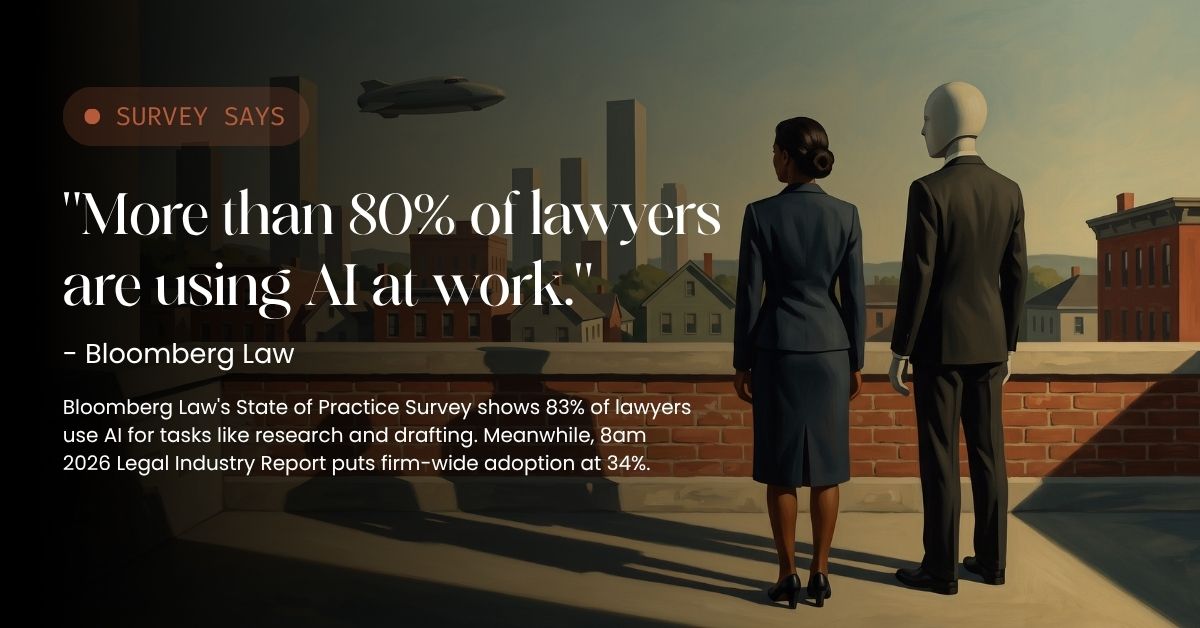
Ask lawyers whether they're using AI, and the answer is overwhelmingly yes. Bloomberg Law's State of Practice survey found individual adoption at 83% in June 2026, and Clio and Litify show similar numbers — Clio's own tracking puts the profession at under 20% in 2023 and 79% by 2024; Litify shows 23% to 78% over roughly the same stretch. All three trace one of the fastest adoption curves professional services has seen.
Ask a different question, though: is the firm itself running on AI? The picture looks a lot less impressive. The 8am 2026 Legal Industry Report puts firm-wide adoption of legal-specific tools at just 34% — up from 21% the year before — even though nearly 70% of individual lawyers say they're already using general-purpose tools at work.
So most of what's actually happening is lawyers quietly running things through ChatGPT on their own laptops, not firms deploying AI as real infrastructure. That distinction matters more than any single adoption number, because it's where the actual risk lives.
Why individual use isn't the same as firm-wide adoption
A firm where half the associates have picked up their own AI habits, and nobody else is quite sure what they're doing with it, isn't really an AI-forward firm. It's an ungoverned one.
A few things tend to be true in that kind of environment. There's usually no clear policy: the 8am report found 43% of firms have no AI policy and no plans to create one, while only 9% have one that's actually enforced — less a training gap than a visibility problem at the leadership level. Data ownership gets murky too: in Clio's UK and Australia State of Legal Tech study, nearly half of lawyers weren't fully confident they still own their client data and case documents, and firms that tried to leave a provider reported delays and extraction fees averaging £12,888 in the UK and A$24,861 in Australia. That uncertainty compounds every time another tool gets picked up informally, one lawyer at a time. And almost nobody is measuring the results — Thomson Reuters' 2026 AI in Professional Services research found only 18% of professionals say their organization tracks AI return on investment, and 40% aren't even sure whether it's tracked at all. Firms are spending real money and real hours on AI right now, largely on faith.
None of this means lawyers were wrong to start using AI on their own. It's a coordination problem more than an adoption problem, and coordination problems don't tend to fix themselves as usage grows — if anything, they get worse.
The real barriers to firm-wide implementation
Talk to firms that have tried this and stalled, and the same handful of issues keeps coming up. Confidentiality and privilege concerns top the list — nobody wants client data touching a system they don't fully understand. Ownership of the rollout is often unclear, with IT, operations, and the managing partners each assuming someone else is driving it. Training rarely matches how lawyers actually work, since a generic onboarding session doesn't translate into matter-specific habits. Tool sprawl is common too, as different practice groups adopt different point solutions that don't talk to each other. And there's usually no real way to measure whether any of it is working, which turns "is this worth it" into a gut call instead of a business decision.
Every one of these is solvable. But only if a firm treats implementation as an actual operational project, not a software purchase.
What firm-wide implementation actually looks like
Firms that get past that 34% mark tend to follow a fairly consistent pattern, whether or not they'd describe it this way.
They map the actual workflow before choosing anything — where the hours really go, matter by matter, role by role — because most firms are working from impressions rather than real data. They customize the AI to the firm rather than to the industry in general, since generic legal AI training doesn't account for a firm's own templates, house style, or practice mix; the firms where adoption sticks are the ones where the system already understands how that particular firm works before day one. (This is what a custom Claude for law firms deployment actually means at North — not a generic wrapper, but Claude itself trained on a firm's own matters before anyone touches it.) They roll it out across every desk at once rather than starting with a handful of enthusiasts — partners, associates, paralegals, and clerks onboarded around the same time, because adoption rarely spreads on its own past the early adopters. They govern it, putting the same kind of oversight around skills, prompts, and workflows that the firm would apply to any other work product. And they measure it, tracking adoption, hours saved, and matter outcomes from day one instead of trying to estimate it after the fact.
The difference shows up clearly in the numbers. Across North's own deployments, firms that left AI adoption ungoverned and self-serve before working with North saw real usage settle around 9% of the firm. After a structured, firm-wide rollout, with dedicated support customizing the system to the firm itself, that number gets closer to 80%.
That's not a marginal gap. It's the difference between AI as a side experiment and AI as how the firm actually runs.
A firm that did this
According to North, Hirschen Singer & Epstein LLP, a New York firm, had tried other legal AI tools before working with North, and those tools mostly sat unused.
The tools themselves weren't really the difference. Most firms in this space are building on the same handful of frontier models at this point. What changed was how the technology got installed: on-site, customized to the firm's actual matters, and rolled out to everyone at once instead of left for individual lawyers to figure out on their own.
The part nobody wants to talk about
Firm-wide adoption isn't just an efficiency story. It's a risk management one too. Courts have now logged more than 1,800 decisions involving fabricated AI-generated citations as of August 2026, and that number keeps climbing — not because the technology got worse, but because ungoverned, ad hoc use produces exactly the kind of error that ends up sanctioned. A lawyer alone with a chat window, no oversight, no verification step, is a predictable failure mode.
Done properly, firm-wide implementation is partly a governance answer to that problem. A system built with citation checks, matter context, and real oversight behaves very differently than a lawyer improvising with a general-purpose chatbot at 11pm before a filing deadline.
Where to go from here
Firm-wide AI adoption isn't really a tooling decision. It's an operational one, closer to a merger integration or a new practice management rollout than a simple software subscription. The firms pulling ahead aren't necessarily the ones with the flashiest AI — they're the ones that treated implementation as seriously as the technology itself.
If you're evaluating what's actually powering these systems — and increasingly, that's Claude — the next question worth asking is what makes a Claude-based deployment different from a wrapper built on top of it.
Sources: Bloomberg Law State of Practice Survey (June 2026); Clio Legal Trends Report; Litify; 8am.law 2026 Legal Industry Report; Thomson Reuters 2026 AI in Professional Services Report; Wolters Kluwer Future Ready Lawyer Survey (2026); Clio State of Legal Tech Report, UK & Australia; Clio Legal Trends for Solo and Small Law Firms (May 2026); AI Hallucination Cases Database, Damien Charlotin.